
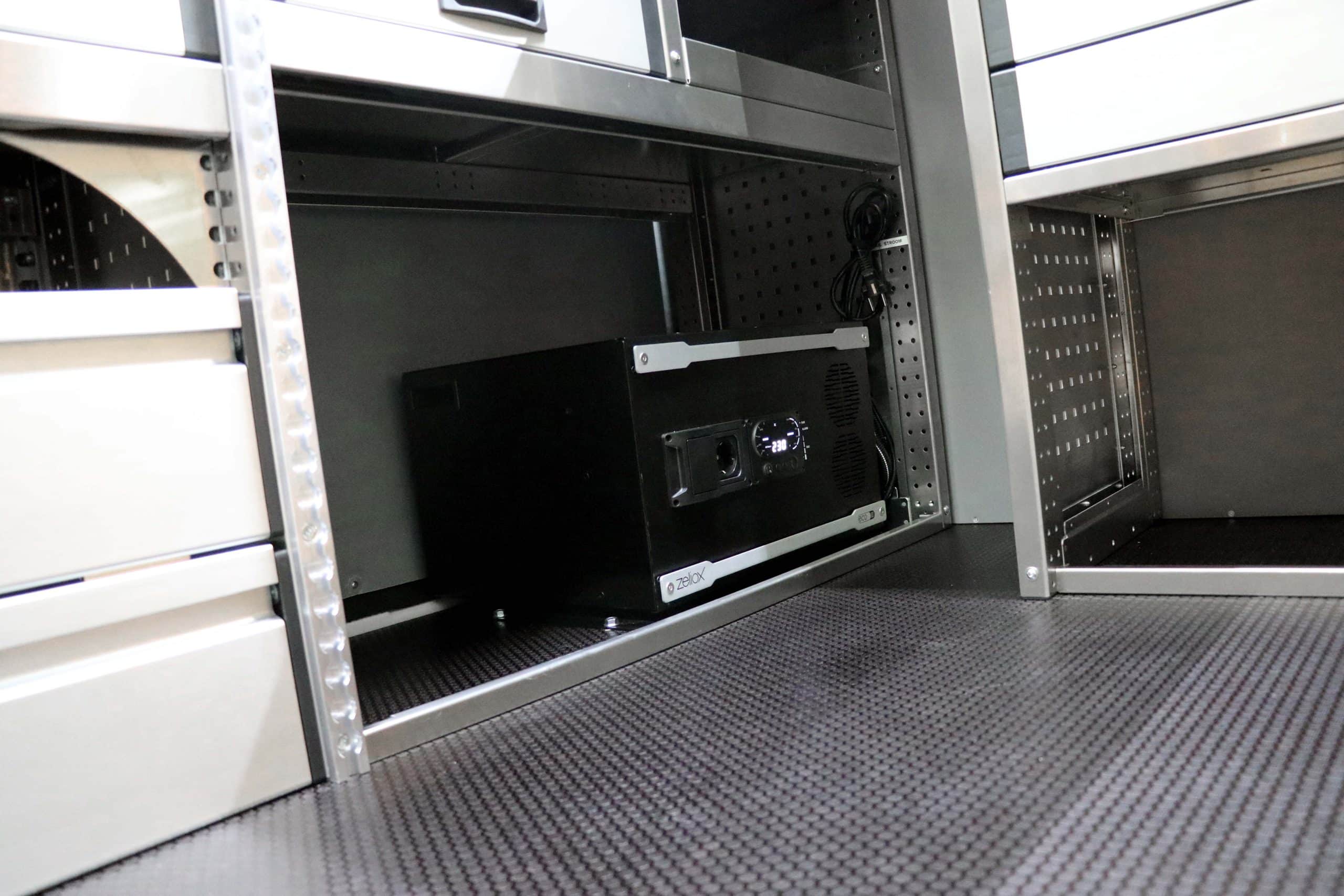
What Is a Portable Power Station?
A portable power station (also called a battery generator or power station) is a rechargeable lithium battery unit that stores electricity and delivers it on demand through multiple outlets. Think of it as a large, high-capacity power bank, but instead of just USB ports, it provides 240V AC power, 12V DC outlets, and USB-C/USB-A ports, capable of running everything from power tools to fridges and small appliances.
The key components inside every power station are:
- Lithium battery pack — stores the energy (typically LiFePO4 in professional-grade units)
- Inverter — converts battery DC power to 240V AC power for standard appliances
- Battery Management System (BMS) — protects the battery from overcharging, overheating, over-discharging, and short circuits
- Charge controller — manages how the battery recharges from AC mains, a vehicle alternator, or solar panels
Power stations range from small units you can carry in one hand (300–500 Wh) to large vehicle-installed systems (2,000–10,000+ Wh) capable of running high-draw tools for a full workday.
Portable Power Station vs. Generator: What’s the Difference?
This is the most common question, and the answer determines whether a power station is right for you.
| Feature | Battery Power Station | Petrol/Diesel Generator |
|---|---|---|
| Fuel | Stored electricity (rechargeable) | Petrol, diesel, or gas |
| Noise | Silent (fan noise only) | 65–100+ dB — hearing protection often required |
| Emissions | Zero | CO, NOx, particulates — never use indoors |
| Maintenance | None (no oil, filters, or spark plugs) | Regular oil changes, filter cleaning, fuel stabiliser |
| Runtime | Limited by battery capacity (2–8 hours typical) | As long as fuel is available (hours to days) |
| Fuel cost | ~$0.30–0.50/kWh from grid | ~$1.50–2.50/L for petrol or diesel |
| Weight | 10–40 kg (vehicle-integrated) | 15–100+ kg |
| Lifespan | 3,000–5,000+ cycles (8–14 years) | 1,000–3,000 hours (~2–5 years typical use) |
The critical trade-off: a generator can run indefinitely on fuel, but you pay for it in noise, fumes, maintenance, and fuel costs. A power station has a finite runtime per charge, but it recharges silently while you drive (via DC-DC charging), costs virtually nothing to maintain, and produces zero emissions.
For tradies who drive between jobs, the vehicle-mounted power station is the sweet spot — the battery charges between every stop, so you rarely run empty.
How a Portable Power Station Works
A portable power station operates in three phases:
1. Charging. The battery pack absorbs energy from a power source:
- 240V AC mains: standard wall outlet, typically 4–6 hours to full
- Vehicle alternator (DC-DC): charges while you drive at 20–50A, topping up in 3–8 hours of driving (depending on battery size and alternator output)
- Solar panels: trickle charge from rooftop or portable panels; output varies by sunlight
2. Storage. The lithium battery holds that energy with minimal self-discharge (LiFePO4 loses about 2–3% per month). The BMS monitors temperature, voltage, and current to keep the cells within their safe operating window.
3. Discharge. When you plug a device in, the inverter converts DC to 240V AC, or DC outlets deliver power directly. The BMS ensures the draw doesn’t exceed the inverter’s rated continuous output or its surge capacity (peak start-up loads like fridges and motors).
Real-world example: A 2,000Wh power station with a 2,000W inverter can run a 1,800W angle grinder for about an hour continuously — or a 100W fridge for 15–20 hours. Most tradies find a 2,000–5,000Wh system covers a full workday on a single charge.
What Can a Portable Power Station Run?
Professional-grade portable power stations can handle nearly every tool and appliance on a typical job site:
Power tools (intermittent use):
- Angle grinders (800–1,800W) — 1–2 hours on a 2,000Wh unit
- Circular saws (1,200–1,800W) — similar runtime
- Impact drivers and drills (300–800W) — 3–6 hours
- Mitre saws (1,500–2,000W) — ~1 hour continuous; longer for intermittent cuts
Appliances:
- 12V/240V fridges (40-100W): 15-20 hours on a 2,000Wh unit
- Laptops and phone chargers (30-100W): days of use
- Microwave ovens (800-1,200W): 30-90 minutes
- Coffee machines (600-1,200W): enough for dozens of brews
- CPAP machines (30-60W): multiple full nights
Site essentials:
- Site lighting (50-200W): 10-40 hours
- Radios and speakers (10-50W): days
- Hot water units (1,000-2,000W): shorter bursts
The key specification is inverter output; this determines what you can run simultaneously. A 2,000W inverter handles most single tools. For running multiple high-draw tools at once, step up to 3,000W+.
What Type of Battery Does a Portable Power Station Use?
Battery chemistry matters enormously for lifespan, safety, and performance.
LiFePO4 (Lithium Iron Phosphate): The professional standard.
- Cycle life: 3,000–5,000+ cycles to 80% capacity
- Lifespan: 8–14 years at one cycle per working day
- Safety: Thermally stable, virtually no fire risk
- Temperature range: Charges from 0°C to 55°C
- Weight: Heavier per kWh than NMC, but the trade-off is well worth it
NMC (Nickel Manganese Cobalt): Common in consumer units.
- Cycle life: 500–1,000 cycles to 80% capacity
- Lifespan: 2–4 years typical
- Safety: Higher energy density but less thermally stable
- Cost: Lower upfront, but replacement comes sooner
AGM / Lead-Acid: Legacy technology, largely phased out.
- Cycle life: 200–500 cycles
- Weight: 2–3× heavier than lithium for the same capacity
- Depth of discharge: Limited to 50% for acceptable lifespan
For professional or fleet use, LiFePO4 is the only sensible choice — the higher upfront cost is repaid several times over in lifespan and reliability.
How Do You Charge a Portable Power Station?
This is where vehicle-mounted portable power stations have a decisive advantage over standalone units.
Charging methods (fastest to slowest):
- DC-DC charging from vehicle alternator: 20-50A / 240-600W. Recharges a 2,000Wh unit in 3-8 hours of driving. This is the game-changer: the battery charges automatically between every job.
- 240V AC mains: 300-1,000W. Full charge in 2-6 hours.
- Solar panels: 100-500W. Output varies heavily by sunlight. Useful as a supplement, but unreliable as a primary source for high daily usage.
- Combined charging: Some units support simultaneous AC + DC charging for the fastest possible recharge.
Zeliox power stations feature integrated DC-DC charging, meaning the unit is wired directly into the vehicle’s auxiliary battery system. When the engine runs, the power station charges. When you park at a job site, it delivers silent power with no engine idling required.
Are Portable Power Stations Worth It for Tradies?
For any tradie who works from a vehicle, the economics stack up quickly.
Direct savings:
- Fuel: Idling a standard van engine burns 0.5–2.0 L/h of diesel. At current Australian diesel prices (~$2.20/L), that’s $1.10–4.40 per hour. Most tradies idle 10–20 hours per week — that’s $11–88 per week, or $570–4,600 per year depending on vehicle size and idling habits. A power station eliminates this cost entirely.
- Engine maintenance: Less idling means longer intervals between oil changes, filter replacements, and top-end overhauls. Conservatively, this saves $500–1,500 per year in reduced engine wear.
- Generator maintenance: No oil changes, spark plugs, or fuel stabiliser for a petrol generator. Save $200–500 per year.
Calculated payback
A 2,000Wh vehicle-mounted power station costs $2,500-4,500 installed. Combined fuel, maintenance, and generator savings typically deliver payback within 12-30 months. Over a 5-year lifespan, the total saving typically reaches $5,000-15,000 per vehicle.
Harder-to-quantify benefits
- No noise complaints from clients, neighbours, or site supervisors
- No lifting heavy jerry cans or generators in and out of a ute
- Cleaner power for tools: pure sine wave output means less stress on sensitive electronics
- A more professional image: arriving on site with a whisper-quiet power system instead of a roaring generator
Common Myths About Portable Power Stations
“Power stations don’t have enough power for real tools.”
Partially true for small consumer units, but professional-grade 2,000W+ inverters can run any tool a single tradie needs. The limitation is runtime when running multiple high-draw tools simultaneously, not the power output itself.
“Batteries degrade too fast.”
LiFePO4 batteries deliver 3,000-5,000 cycles before dropping to 80% capacity. At one cycle per working day, that’s 8-14 years. Most tradies replace their ute before they replace the battery.
“They’re too expensive.”
The upfront cost is higher than a budget petrol generator, but running costs are near zero. The payback calculation above demonstrates it’s cheaper over the life of the unit.
“You can’t run them in rain or dust.”
Professional vehicle-installed units are typically rated IP54 or better, meaning dust-protected and splash-resistant. They’re built for Australian conditions.
Solar Generator vs. Portable Power Station — What’s the Difference?
The terms “solar generator” and “portable power station” are often used interchangeably, but they’re technically distinct. A solar generator is simply a portable power station paired with solar panels for recharging. No generation occurs in the traditional sense. The panels charge the lithium battery, and the battery delivers power through an inverter.
If you already own a portable power station with an MPPT solar charge controller, adding solar panels converts it into a solar generator system. For tradies working in remote areas — mining sites, roadside call-outs, rural fencing — a roof-mounted solar panel on the work van can significantly extend runtime on sunny days, reducing reliance on mains charging.
However, solar alone isn’t reliable enough for daily professional use in most Australian climates. The most practical setup for tradies combines solar input with a DC-DC charger wired to the vehicle alternator. The lithium battery charges from the alternator while you’re driving between jobs, and the solar panel tops it up when you’re parked. This hybrid approach gives you the best of both: silent job-site power with zero refuelling stops.
Fuel-burning generators are increasingly being replaced by battery and solar systems across most job-site applications. Only scenarios requiring very high continuous power like heavy welding, multi-crew demolition sites, or extended remote camp operations still genuinely require a conventional generator.
About Zeliox: Zeliox designs and manufactures all-in-one power products for professional vehicles and fleet operators. Every system is built around LiFePO4 battery technology with integrated DC-DC charging, pure sine wave inverters, and a BMS engineered for Australian conditions. Stop waiting, start working.