
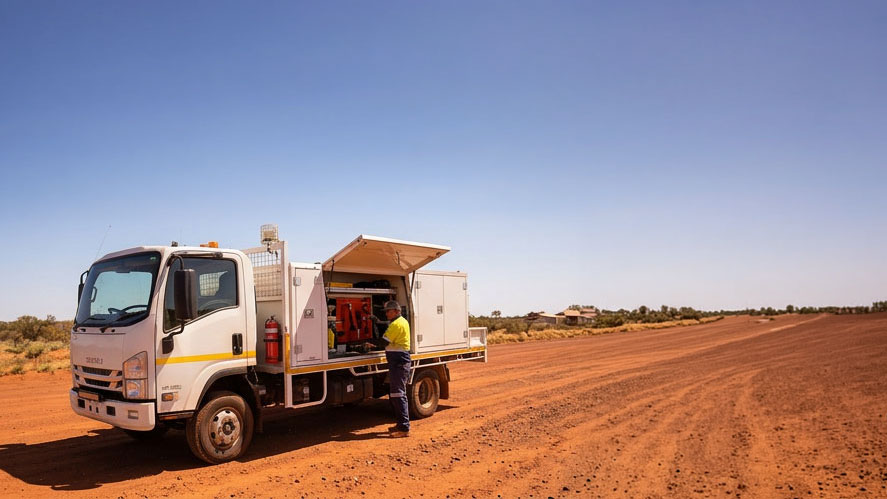
It’s 2 AM at a truck stop off the Hume Highway. Your driver has been asleep in the cab for four hours. The engine is running. The cab is a comfortable 22°C. The CPAP machine hums beside the pillow.
To you, watching the telematics feed from your office, it looks like negligence. Another truck, another driver, burning fuel for no reason.
But your driver isn’t being careless. He’s solving a problem your fleet hasn’t solved yet. And the sooner you see idling the way he does, the sooner you can actually fix it.
This is the behavioural iceberg of fleet idling. What you see on the dashboard — hours, litres, engine runtime percentage — is a tiny fraction of what’s driving the behaviour. Below the waterline: infrastructure gaps, operational pressures, safety instincts, and decades of habit.
Fleet managers ask us this all the time: “Why do our drivers keep idling?” The honest answer is they almost never idle because they don’t care. They idle because something in their working environment is asking them to.
This article is about that gap — what drives idling behaviour, what it’s costing your fleet, and what a real solution looks like.
The Real Reasons Your Drivers Idle
Let’s start with the reframe that changes everything.
Idling is almost never a discipline problem. It’s an infrastructure problem.
When drivers idle, they’re usually making a rational decision based on the only tools available to them. The engine is a generator. The cab is their office, their bedroom, and their break room. When they shut the engine off, they lose all of it.
Drivers don’t idle because they haven’t been told to stop. They idle because turning the engine off means choosing between discomfort and compliance — and most people choose comfort.
This distinction matters. If you believe drivers are idling because they don’t care, you’ll respond with stricter policies, more coaching, and more monitoring. If you understand they’re idling because their environment forces them to, you’ll start looking for the actual fix.
One of those approaches works. The other keeps showing up in your telematics data year after year.
The Comfort Equation
Climate control is the single largest driver of discretionary idling.
Research from the U.S. Department of Energy and the U.S. Environmental Protection Agency shows that approximately 70% of long-haul truck drivers idle their engines for several hours during overnight breaks to manage cab temperature. This finding is corroborated by NACFE and ATRI. While the figure comes from U.S. research, the Australian Trucking Association (ATA) confirms the same behavioural pattern holds locally — seven out of ten trucks parked at a rest stop with the engine running are doing so because the driver needs to sleep, and sleeping in a cab without climate control means either freezing in winter or broiling in summer.
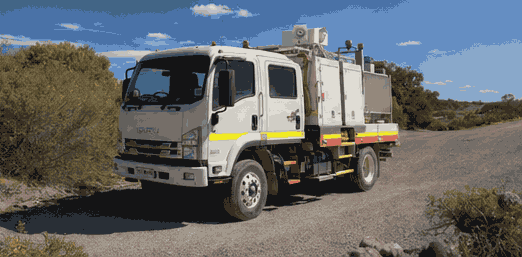
Truck cabs absorb heat and cold faster than most people realise. On a 40°C day in the interior, a parked cab becomes uninhabitable within an hour. On a frosty night in inland Queensland, temperatures drop to bone-cold before dawn. Drivers aren’t idling because they’re soft — they’re idling because a cab without HVAC is genuinely uncomfortable and, in some conditions, genuinely unsafe.
But it’s not just temperature.
Modern drivers carry a load of personal electronics that need power: phones, tablets, and entertainment devices. Many run a small fridge to keep food and drinks from spoiling. An estimated 30% of truck drivers use CPAP machines — roughly one in three — and those machines require continuous power through the night. A driver who can’t power their CPAP doesn’t sleep. A driver who doesn’t sleep doesn’t pass their next medical.
The engine has always been the only power source available in a parked truck.
So it keeps running.
This is the comfort equation, and it’s not simple. Every one of those power needs is legitimate. Drivers aren’t being wasteful — they’re meeting basic requirements their employer hasn’t provided an alternative for.
The Waiting Game
A significant portion of fleet idling isn’t discretionary at all. It’s operational.
Drivers idle at docks because they don’t know when the door will open. They idle in heavy vehicle safety station queues that stretch for kilometres. They idle in peak-hour traffic that has stopped moving but hasn’t cleared. They idle because they’re paid by the kilometre, not by the hour — and turning the engine off during a waiting period doesn’t save the fleet anything.
Detention time is one of the most frustrating and least-discussed costs in freight. A driver who arrives on time but waits three hours to unload is still on the clock, still needs climate control, and still has a delivery window to meet.
The engine idles because the schedule has no buffer, the dock has no priority system, and the driver is doing the only thing they can: stay comfortable and ready to move.
Inspection Delays.
Inspection delays are another quiet culprit. Under the National Heavy Vehicle Regulator (NHVR) framework, drivers pulled for inspection often keep the engine running because they don’t know how long they’ll be held, they may need to move at any moment, and restarting a cold engine mid-queue is inconvenient at best.
This category of idling — waiting, queuing, scheduled uncertainty — doesn’t respond to driver coaching. It responds to operational improvement: better appointment systems, faster docks, smarter scheduling. Until those systems are in place, the idling continues.
Safety Theatre and Cargo Protection
Some idling serves a purpose that managers don’t always appreciate from the office.
In extreme cold — alpine routes, early morning starts in Tasmania, the New England highways in winter — drivers sometimes idle to prevent fuel gelling, to keep brake systems from freezing, or to maintain battery charge for starting. These aren’t myths. They’re real concerns in certain conditions, even if sometimes overstated by drivers who’ve never had to manage without the engine running.
Cargo protection is another factor. Drivers hauling temperature-sensitive freight — meat, dairy, pharmaceuticals, produce — sometimes idle to maintain load temperature during rest periods, particularly if the reefer unit isn’t sufficient for the conditions or the ambient temperature differential is extreme. Even when the cargo technically doesn’t require active cooling, a driver responsible for a load worth tens of thousands of dollars will err on the side of caution.
Then there’s the perception factor. Some drivers idle because they feel safer with the engine running — it deters opportunistic theft, keeps the cab defensible, and provides a quick exit if something goes wrong at an isolated rest stop on a lonely stretch of the Stuart Highway. This isn’t irrational. A parked truck at a remote stop at 3 AM is a vulnerable asset. A running engine is a signal, even if an imperfect one.
None of these reasons are entirely wrong. Some are partially outdated, some are perception-based rather than fact-based, and some are habits formed when no alternative existed. But dismissing them as irrational doesn’t make them go away. Addressing them does.
The Habit Problem
A large portion of idling is neither necessary nor rational. It’s just habit.
For decades, idling was the only option. Drivers didn’t think about it — they just did it, the way their mentors did, the way every driver they’d ever worked alongside did. The engine ran when the truck was parked because turning it off meant giving something up, and no one had given them a reason to do otherwise.
This is where the data gets uncomfortable for fleet managers who’ve built their idling strategy around “just tell them to stop.”
Research from Argonne National Laboratory and the U.S. Department of Energy shows that for heavy diesel engines at operating temperature, restarting uses less fuel than idling for periods as short as 30 seconds to 3 minutes, depending on engine size and operating temperature. The often-cited “10-second rule”? That applies to passenger vehicles, not heavy trucks. For a prime mover with a 15-litre diesel at operating temperature, the breakeven can extend closer to three minutes. That means the common practice of idling “just for a few minutes” is significantly more wasteful than simply shutting the engine off and restarting it.
Let that sink in. A driver who idles for five minutes at a loading dock is burning more fuel than a restart would consume, and accumulating engine hours, exhaust system wear, and maintenance costs for nothing in return. The warm-up idle — one of the most entrenched habits in trucking — is, in most modern engines, completely unnecessary.
Yet it persists. Habit is stronger than data, and no one has given drivers a replacement that feels as safe and familiar as what they’re already doing.
Changing habits requires replacing the infrastructure that creates them. Telling someone to stop doing something without offering an alternative doesn’t work — it just creates resentment and non-compliance.
PTO, Refrigeration, and Legitimate Operational Idling
Before we get to the cost data, let’s be honest about something important: some idling is necessary.
PTO-driven operations — concrete agitators, tip trucks, service vehicles — frequently need the engine running to power hydraulic systems, air compressors, or equipment attachments. Refrigerated trailers require the reefer unit to run continuously to maintain load temperature. Livestock transport requires ventilation and climate monitoring in extreme heat. Field service trucks often power tools and equipment directly from the drivetrain.
This idling isn’t waste. It’s operational necessity. Any serious approach to reducing fleet idling has to account for it honestly.
The goal isn’t zero idling. The goal is eliminating unnecessary idling while preserving the idling that genuinely serves a purpose. A fleet that ignores legitimate operational idling in pursuit of a 0% idle rate will create real problems: unhappy drivers, operational failures, and a credibility gap that makes harder conversations about unnecessary idling far more difficult to have.
The answer isn’t a mandate. It’s an infrastructure upgrade that handles the loads and needs currently requiring the engine to run — so that the only idling left is the kind that genuinely can’t be avoided.
What Idling Actually Costs Your Fleet
Now the numbers.
The average heavy vehicle in Australia idles between 1,000 and 1,800 hours per year. That’s six weeks to nearly three months of engine runtime on a parked truck.
When idling, a heavy vehicle burns between 2 and 4 litres of diesel per hour. Using 3 L/hr as a midpoint for a typical fleet profile:
At $2.80/L — roughly the midpoint of current Australian diesel pricing, which ranges from $2.50 to $3.10/L depending on state, location, and wholesale conditions — a single truck idling eight hours per day over 300 operational days per year burns through:
8 hours × 3 L/hr × $2.80/L × 300 days = $20,160 in fuel per truck, per year.
That’s fuel alone. It doesn’t include engine wear from thousands of hours of unnecessary runtime, increased maintenance intervals, higher oil consumption, or accelerated degradation of exhaust aftertreatment systems — including diesel particulate filters (DPFs), which cost $15,000 to $25,000 AUD to replace on a heavy vehicle in Australia.
Scale that to a 50-truck fleet and you’re looking at over $1,000,000 per year in direct fuel costs — with hidden maintenance and equipment costs layered on top.
Scale it to 200 trucks and you’re approaching $4 million annually. For idling.
Fleet Idling Cost Calculator
| Fleet Size | Daily Idle (hrs) | Days/Year | L/hr | Diesel Price | Annual Cost |
|---|---|---|---|---|---|
| 1 truck | 8 | 300 | 3 | $2.80/L | $20,160/yr |
| 50 trucks | 8 | 300 | 3 | $2.80/L | $1,008,000/yr |
| 100 trucks | 8 | 300 | 3 | $2.80/L | $2,016,000/yr |
| 200 trucks | 8 | 300 | 3 | $2.80/L | $4,032,000/yr |
Fuel cost only. Does not include maintenance, engine wear, DPF degradation, or other equipment costs.
Note: At $2.80/L — well within the current Australian range — a single truck’s annual idle fuel cost reaches $20,160, and a 50-truck fleet exceeds $1,000,000 in wasted fuel alone.
Driver turnover compounds the problem. Industry research puts the cost of replacing a single driver at $10,000 to $15,000 — factoring in recruitment, training, onboarding, and the productivity gap while a seat sits empty. Driver comfort, including the ability to rest properly without idling, ranks as a top-three retention factor. A fleet that treats driver comfort as a cost centre rather than a retention strategy tends to see higher turnover, higher training costs, and greater difficulty attracting new drivers in an industry already stretched for qualified talent.
The Path Forward: Solving Idling Without Compromising Your Drivers
Here’s the conclusion that changes the conversation.
Every driver described in this article is a rational person responding to real problems — comfort needs, operational pressures, safety concerns, and habits formed over decades in an industry that never gave them a better option.
Fleets that have actually solved their idling problem didn’t do it by coaching harder. They did it by giving their drivers a better alternative.
Zeliox is that alternative.
Zeliox delivers all-day battery power for commercial vehicles — climate control, device charging, CPAP support, fridge, laptop, diagnostics — everything a driver needs to stay comfortable and productive while the engine remains off. No fuel burned. No engine wear. No noise. No compromises.
For fleet managers, that means eliminating thousands of dollars in annual idle fuel cost per truck, reducing engine maintenance intervals, supporting driver retention, and demonstrating genuine environmental commitment — all without asking drivers to give up anything that matters to them.
The path forward isn’t telling drivers to stop idling. It’s giving them a reason to.
Next step: Before you can solve idling, you need to measure it. Fleet telematics is the right place to start — most modern platforms flag idle events automatically, giving you an accurate baseline for your fleet’s idle profile before you design a solution.
Once you know where your idle hours come from, the conversation changes.
Sources: U.S. Department of Energy; U.S. Environmental Protection Agency; Argonne National Laboratory; Australian Trucking Association (ATA); National Heavy Vehicle Regulator (NHVR); North American Council for Freight Efficiency (NACFE); American Transportation Research Institute (ATRI).